Home /
Naturtejo UNESCO Global Geopark /
Geology and Archaeology Route at Rodao, Vila Velha de Ródão
Geology and Archaeology Route at Rodao, Vila Velha de Ródão
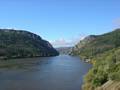
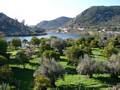
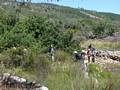
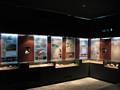
The Geology and Archaeology Route of Rodao takes visitors on a 500 million year journey dating back to the beginnings of the sediments which gave origin to the quartzite of the Serra das Talhadas. One of the high points of this route is the lookout over the Doors of Rodao, a colossal geomorphological structure that results from the transposition of the Tejo River through the quartzite crest. Close to this location various demonstrations by organisms that left their marks on ancient sands can be seen. Today these are fossilised and bear witness to the important episodes of the region´s geological evolution. There are also large trees, related to custard apple trees, typical of hot climates, that were plentiful in this location. The petrified trunks in the Tejo Hall of Arts and Culture prove this. For a better understanding of the Tejo River system, the route continues on to the terraces of the Excarrique Falls and the Falls Senhora da Alagada, which bear evidence to the successive embedding of the Tejo River. On the terrace of the Enxarrique Falls, classified as Real Estate of Public Interest, fossils of deer, aurochs, elephant, and rhinoceros were found from the end of the Middle Palaeolithic Period. The oldest remnants of human occupation of the Naturtejo Geopark were recorded in the Vila Velha de Rodao (Monte do Famaco) and some of these can be seen in the Archaeology Hall of the Municipal Museum.

CHARACTERISTICS
LOCATION
Address: Starting point at Casa das Artes e Cultura do Tejo, Rua de Santana
City: Vila Velha de Ródão
Postal Code: 6030 - 230
Telephone: 272320176
Email: geral@naturtejo.com
Website: http://www.naturtejo.com
City: Vila Velha de Ródão
Postal Code: 6030 - 230
Telephone: 272320176
Email: geral@naturtejo.com
Website: http://www.naturtejo.com
FUNCTIONING
Public venue, with no timetable or entrance fee.
ORGANISATION OF THE VISIT
The visit to this Point requires prior booking and cannot be done individually.
Specific Conditions:
The Trail is not marked, and advance scheduling is required for visitation. Tours are guided by specialised technicians from the Geopark Naturtejo are paid for in accordance with the number of participants.
Method:
On foot
Difficulty Level:
Average
Group Visits:
No
Guided Tours:
No
Observations:
-
Specific Conditions:
The Trail is not marked, and advance scheduling is required for visitation. Tours are guided by specialised technicians from the Geopark Naturtejo are paid for in accordance with the number of participants.
Method:
On foot
Difficulty Level:
Average
Group Visits:
No
Guided Tours:
No
Observations:
-
EXISTING EQUIPMENT
Geological curiosity
GEOLOGICAL / MINING INTEREST
History Patrimony:
-
Activity Program:
-
Study and Research Unit:
-
Audiovisual and Multimedia Resources:
-
Volunteering Programs:
-
-
Activity Program:
-
Study and Research Unit:
-
Audiovisual and Multimedia Resources:
-
Volunteering Programs:
-
EXTERNAL SUPPORT
Where to Stay
http://www.turismodocentro.pt/guiaalojamento.pdf
Where to Eat
http://www.cm-vvrodao.pt/principal.php?cont=8&sub=29&letra=p&lg=1
Cultural Facilities
http://www.cm-vvrodao.pt/principal.php?cont=7&letra=p&lg=1
Security Forces
http://www.portaldasaude.pt/portal/servicos/prestadoresV2/?providerid=393
http://www.turismodocentro.pt/guiaalojamento.pdf
Where to Eat
http://www.cm-vvrodao.pt/principal.php?cont=8&sub=29&letra=p&lg=1
Cultural Facilities
http://www.cm-vvrodao.pt/principal.php?cont=7&letra=p&lg=1
Security Forces
http://www.portaldasaude.pt/portal/servicos/prestadoresV2/?providerid=393
TRANSPORT
Type of Transport:
T. Ferroviário
Agency Name:
CP
Telephone Number:
808208208
Type of Transport:
T. Rodoviário
Agency Name:
Rodoviária da Beira Interior
Telephone Number:
272340120
Parking for private vehicles:
Yes
T. Ferroviário
Agency Name:
CP
Telephone Number:
808208208
Type of Transport:
T. Rodoviário
Agency Name:
Rodoviária da Beira Interior
Telephone Number:
272340120
Parking for private vehicles:
Yes
SITES OF TOURISTIC INTEREST
House of Arts and Culture of Tejo
This project is the pure contrast of history and tradition with the future and progress. A sophisticated construction, projected to all ages, which favours the contact with the contemporary arts. In this house are promoted a series of temporary exhibitions of visual arts, photography, theatrical, musical, dancing performances and many other promotional and training events.
gps: 39.65498 -7.67457
distance: 1km
Foz do Cobrão Village
Located at the west slope of Talhadas Hill, this town is an excellent proposal to the Nature and Geological Heritage lovers, as they can find impressive landscapes and a high diversity of fauna and flora. One of the principal attractions is the Portas de Almourão Geomonument.
gps: 39.73082 -7.76002
distance: 16km
King Wamba’s Castle
Raising itself in one of the Tejo River’s scarp, this Castle is an ancient construction dating from the VII century, which testified historic events like the Seven Year War or the First French Invasion.
gps: 39.6438 -7.68803
distance: 2km
Olive Oil Pole Press
Located at the Porto do Tejo in Vila Velha de Rodão, the Olive Oil Pole Press is a tourist project that reclassifies an industrial complex typical in the region which provides a unique experience around the olive oil. It has a permanent exhibition about the regional olive oil, "Olive oil: Rodão’s Gold".
gps: 39.65418 -7.66944
distance: 1km
This project is the pure contrast of history and tradition with the future and progress. A sophisticated construction, projected to all ages, which favours the contact with the contemporary arts. In this house are promoted a series of temporary exhibitions of visual arts, photography, theatrical, musical, dancing performances and many other promotional and training events.
gps: 39.65498 -7.67457
distance: 1km
Foz do Cobrão Village
Located at the west slope of Talhadas Hill, this town is an excellent proposal to the Nature and Geological Heritage lovers, as they can find impressive landscapes and a high diversity of fauna and flora. One of the principal attractions is the Portas de Almourão Geomonument.
gps: 39.73082 -7.76002
distance: 16km
King Wamba’s Castle
Raising itself in one of the Tejo River’s scarp, this Castle is an ancient construction dating from the VII century, which testified historic events like the Seven Year War or the First French Invasion.
gps: 39.6438 -7.68803
distance: 2km
Olive Oil Pole Press
Located at the Porto do Tejo in Vila Velha de Rodão, the Olive Oil Pole Press is a tourist project that reclassifies an industrial complex typical in the region which provides a unique experience around the olive oil. It has a permanent exhibition about the regional olive oil, "Olive oil: Rodão’s Gold".
gps: 39.65418 -7.66944
distance: 1km
ASSOCIATED ROUTES
SUGGESTIONS OF THE ROUTE- OTHER NEARBY PLACES TO VISIT